


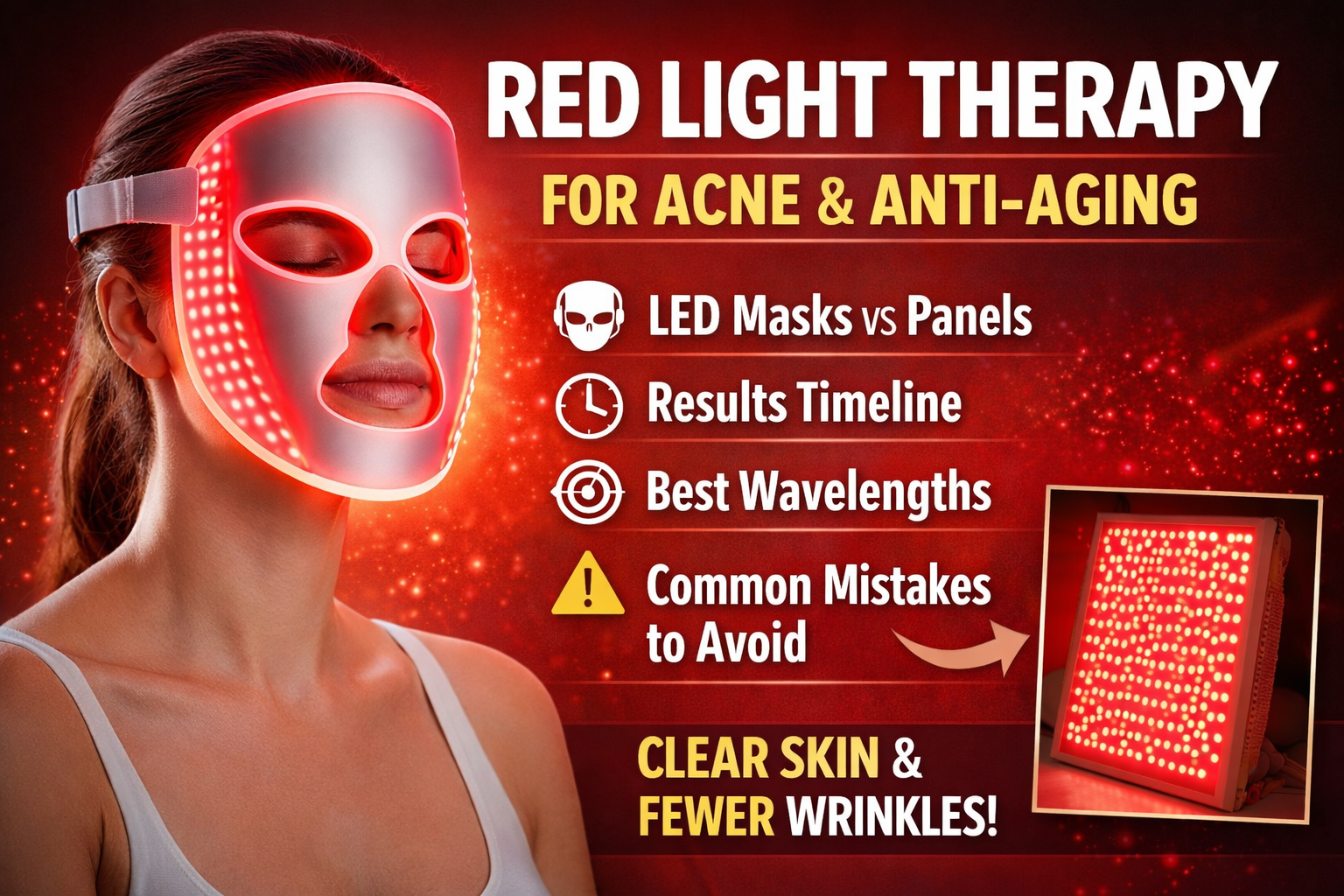
Red Light Therapy for Acne and Anti-Aging: LED Masks, Panels, Results Timeline, and Mistakes
Outline (Step-by-Step Roadmap)
-
What red light therapy really is (photobiomodulation, not “heat”)
-
Red vs blue vs near-infrared: which light does what
-
Acne: how LED light helps (and where it won’t)
-
Anti-aging: collagen, inflammation, and texture
-
What studies and dermatology orgs actually say
-
LED masks vs LED panels vs in-office treatments
-
Buying guide: wavelengths, irradiance, dose, FDA-cleared devices
-
Safety rules: eyes, photosensitivity, medications, melasma risk
-
How to use it: routine, frequency, session length
-
Results timeline: what you can expect week by week
-
How to combine LED with skincare actives (retinoids, acids, BP)
-
The biggest mistakes people make (and how to fix them)
-
Troubleshooting: “Why am I not seeing results?”
-
Sample routines for acne-prone and anti-aging goals
-
Pro tips: tracking progress and knowing when to upgrade
-
Conclusion
-
5 FAQs (with answers)
1) What Red Light Therapy Actually Is (And What It Isn’t)
Red light therapy is also called photobiomodulation—a fancy word for a simple idea: specific wavelengths of light can trigger helpful cellular activity. Dermatology sources describe it as non-invasive red or near-infrared light used for concerns like acne and signs of aging.
What it is not:
-
It’s not a tanning bed.
-
It’s not “cooking” your skin.
-
It’s not instant Botox in LED form.
Think of it like giving your skin cells a gentle “charging cable”—not a violent reset. Consistency matters more than intensity.
2) Red vs Blue vs Near-Infrared Light (The Cheat Sheet You Needed Yesterday)
Most effective acne/anti-aging devices revolve around three bands:
Red light (commonly ~630–660 nm)
Red light is the “calm down and rebuild” signal. Studies on LED phototherapy often use red wavelengths like 633 nm in skin rejuvenation research.
Near-infrared (often ~810–850 nm)
Near-infrared (NIR) penetrates deeper than visible red. Many rejuvenation protocols use combos like 633 nm + 830 nm.
Blue light (commonly ~405–420 nm)
Blue light targets acne mechanisms more directly, especially mild-to-moderate inflammatory acne. Reviews note evidence for blue and blue-red combination light improving inflammatory lesions.
Quick metaphor:
-
Blue light is the bouncer kicking trouble out of the club.
-
Red/NIR is the cleanup crew + renovation team that repairs what the chaos left behind.
3) How LED Light Helps Acne (Real Benefits, Real Limits)
Let’s be clear: light therapy can reduce acne, but it rarely clears acne all by itself. Dermatology guidance says lasers/lights can reduce acne, but most people need combination treatment for best results.
Here’s what LED can realistically do:
Reduce inflammatory breakouts
Evidence suggests blue and blue-red LED therapy can help mild to moderate inflammatory acne.
Support healing + calm redness
Health-system guidance describes red light therapy as promoting healing and reducing inflammation, and differentiates it from photodynamic therapy approaches.
Improve consistency (less “angry skin”)
If your acne is partly driven by irritation, barrier damage, or inflammation from overuse of actives, red/NIR can help make your skin more stable—so your actual acne routine works better.
What LED typically won’t fix alone:
-
Hormonal acne without addressing hormones
-
Cystic acne that needs prescription care
-
Comedonal acne (clogged pores) without exfoliation/retinoids
4) How LED Helps Anti-Aging (Collagen, Texture, and “Tired Skin”)
Anti-aging claims get loud online, so let’s keep it grounded.
Clinical literature reports that 633 nm and 830 nm LED treatments can play a role in photodamaged skin, and LED phototherapy has been investigated for skin rejuvenation outcomes.
In normal language, consistent red/NIR use can help:
-
Fine lines look softer
-
Skin tone looks more even
-
Texture looks smoother
-
Redness/inflammation looks reduced
Don’t expect:
-
Deep wrinkle erasure
-
Lift like surgery
-
A face transplant in 10 minutes
Think “slow upgrade,” not “overnight makeover.”
5) What the Science and Dermatology Organizations Say (The No-Hype Verdict)
If you only remember one thing, remember this:
-
The American Academy of Dermatology describes red light therapy as non-invasive and notes dermatologists may use it for acne and signs of aging, with professional devices being more powerful than most at-home gadgets.
-
For acne specifically, the AAD notes light/laser treatments can reduce acne, but they rarely clear acne alone.
-
Research reviews suggest blue or blue-red light can help mild-to-moderate inflammatory acne, but more robust comparisons and longer follow-ups are still needed.
If you want to read from an authoritative dermatology source directly, here’s the AAD page: red light therapy guidance from the American Academy of Dermatology.
6) LED Masks vs LED Panels vs In-Office Treatments (Which One Makes Sense?)
LED masks
Best for: convenience, face coverage, consistent use
Pros: easy habit, targeted facial treatment
Cons: fit issues, uneven contact, often lower power than professional equipment
LED panels
Best for: face + neck + chest, higher coverage, more flexibility
Pros: broader area, often stronger output, can treat body acne too
Cons: less “plug-and-play,” positioning matters
In-office LED / light-based therapy
Best for: people who want higher power + professional protocol
AAD notes professional treatments can be more powerful than at-home devices.
Rule of thumb:
If you know you’ll use it 3–5x/week, a home device can be worth it. If you’re inconsistent, you’ll be paying for a very fancy dust collector.
7) Buying Guide: The Specs That Actually Matter (High-Intent, High-CPC Stuff)
If you want “high value” search terms (and devices worth owning), focus on these:
A) Wavelengths (nm)
For acne + anti-aging, look for:
-
Blue (~405–420 nm) for acne
-
Red (~630–660 nm) for anti-aging and calming
-
Near-infrared (~810–850 nm) for deeper support
Clinical and review literature frequently discusses bands like 415 nm, 633 nm, and 830 nm.
B) Irradiance (power delivered)
Brands love hiding this. You want a device that tells you:
-
irradiance at a specific distance (mW/cm²)
-
session time
-
recommended frequency
C) Dose (energy delivered)
Dose depends on irradiance × time. More isn’t always better—too much can irritate sensitive skin.
D) Coverage and fit
A “powerful” mask that leaves gaps around your jawline is like brushing your teeth but skipping the molars.
E) FDA-cleared / safety classification
Many reputable consumer masks emphasize FDA clearance for certain indications; independent shopping guides also highlight FDA clearance as a key filter for LED masks.
(Just be careful with marketing language: “FDA registered,” “FDA compliant,” and “FDA cleared” aren’t the same thing.)
8) Safety Rules (Don’t Skip This Part)
Red light therapy is generally considered low risk when used correctly, but you still need boundaries.
Eye protection matters
Even when a device “feels gentle,” bright LEDs can strain eyes. If your mask doesn’t protect eyes well, use the provided shields or keep eyes closed.
Photosensitivity
If you:
-
take photosensitizing medications
-
have a photosensitive condition
-
have a history of light-triggered rashes
…talk to a professional first.
AAD guidance emphasizes safety considerations and that professional versions are more powerful.
Hyperpigmentation / melasma caution
Heat and inflammation can worsen pigment in some people. LED isn’t “heat-based” like lasers, but wrong use (too much time, too close, combining with irritating actives) can still cause irritation that triggers pigment.
9) How to Use LED Like a Pro (Simple Routine That Works)
Here’s a practical, repeatable method:
Step 1: Cleanse
Use a gentle cleanser. No heavy oils or thick occlusives before LED—light needs a clean path.
Step 2: Dry your skin
Water can reflect/scatter light. Pat dry.
Step 3: LED session
Follow the device protocol. Common ranges:
-
10 minutes for many masks
-
10–20 minutes for many panels (distance matters)
Step 4: Apply your skincare
After LED, apply soothing hydration:
-
ceramides
-
panthenol
-
niacinamide (if tolerated)
Step 5: SPF in the morning
If you’re using acne actives or chasing anti-aging results, sunscreen is not optional. You can’t out-LED UV damage.
10) Results Timeline (Acne vs Anti-Aging, Week by Week)
Let’s talk expectations—because unrealistic expectations are the #1 reason people rage-quit.
Acne timeline
-
Week 1–2: skin may feel calmer; fewer “angry” flareups
-
Week 3–6: visible reduction in inflammatory lesions for many mild/moderate cases (especially blue/red combo)
-
Week 8–12: best window to judge results realistically
Clinical studies on light therapy masks show measurable lesion improvements over multi-week protocols.
Anti-aging timeline
-
Week 2–4: subtle glow, less dullness
-
Week 6–10: improved texture, fine lines can soften
-
Week 12+: more noticeable change if you stay consistent
The key: LED is like compound interest. Small gains stack.
11) LED + Skincare Actives: What to Combine (And What to Separate)
This is where people accidentally sabotage results.
Safe, smart pairings
-
LED + barrier repair moisturizer
-
LED + niacinamide (if your skin likes it)
-
LED + gentle hydrating serums
-
LED + azelaic acid (often tolerable for acne/redness)
Use caution (separate by time if sensitive)
-
Retinoids (can irritate; many prefer retinoid at night, LED earlier)
-
Benzoyl peroxide (can be drying/irritating)
-
Strong AHAs/BHAs (overdoing can inflame skin)
Simple rule:
If your skin gets irritated easily, don’t stack “high stimulation” on the same day at the start. Build tolerance like you would at the gym.
12) The Biggest Mistakes People Make (And How to Fix Them)
Here are the mistakes I see constantly—especially with LED face masks and red light therapy panels.
Mistake 1: Using it randomly
LED rewards consistency. Treat it like brushing your teeth, not like a “special occasion” product.
Mistake 2: Expecting acne to vanish in 7 days
AAD says light treatments rarely clear acne alone. Use LED as a supportive tool, not your entire strategy.
Mistake 3: Choosing the wrong device for your goal
If acne is the main issue, blue + red often makes more sense than red-only. Reviews highlight effectiveness of blue and blue-red combos for inflammatory acne.
Mistake 4: Wearing it over heavy skincare
Light can’t “push through” thick layers effectively. Keep it clean first.
Mistake 5: Too close, too long, too intense
More light isn’t always better. Overuse can irritate, and irritated skin ages faster.
Mistake 6: Ignoring eye safety
Bright LEDs can strain eyes. Don’t gamble with your vision for skincare.
Mistake 7: Mixing LED with aggressive actives immediately
Start with LED on “calm” days first, then stack slowly.
Mistake 8: No progress tracking
If you don’t track, you’ll feel like nothing is happening and quit right before results show.
Mistake 9: Buying based on influencer hype
Specs matter more than hype. Wavelength, dose guidance, safety, build quality.
Mistake 10: Skipping sunscreen
Anti-aging without SPF is like trying to fill a bucket with a hole in it.
13) Troubleshooting: “Why Am I Not Seeing Results?”
If you’ve used LED for 4–8 weeks and you feel stuck, check these:
A) Are you consistent enough?
3–5 sessions/week usually beats 1 long session/week.
B) Are you treating the right acne type?
If your acne is hormonal/cystic, you may need prescription support.
C) Are you using a weak device at the wrong distance?
Panels especially depend on correct distance. If you stand too far back, you may be getting a “dim flashlight” dose.
D) Is irritation cancelling your progress?
Over-exfoliation + retinoids + LED + no moisturizer = angry barrier = more breakouts.
14) Sample Routines (Acne-Prone vs Anti-Aging)
Routine A: Acne-prone (beginner-friendly)
Morning
-
Gentle cleanser
-
Light moisturizer
-
SPF
Evening
-
Cleanser
-
LED (blue/red combo if available)
-
Moisturizer
-
Add acne active 2–4 nights/week once stable (like adapalene or azelaic acid, based on tolerance)
Routine B: Anti-aging (texture + glow)
Morning
-
Cleanser
-
Vitamin C (if tolerated)
-
Moisturizer
-
SPF
Evening
-
Cleanser
-
LED (red/NIR)
-
Moisturizer
-
Retinoid on alternate nights (once your barrier is happy)
15) Pro Tips: How to Track Progress Like a Skincare Nerd (In a Good Way)
Want results you can actually prove?
-
Take photos in the same spot, same lighting, same time of day weekly.
-
Track acne by counting lesions (sounds tedious, but it’s accurate).
-
For anti-aging, focus on texture and fine lines rather than chasing “lift.”
Also: give yourself enough time. Many protocols run 8–12 weeks before you judge.
Conclusion
Red light therapy can be a genuinely useful tool—especially when you treat it like a consistent routine, not a miracle trick. For acne, blue light and blue-red combinations tend to shine for mild-to-moderate inflammatory breakouts, while red/NIR helps calm inflammation and support healing. For anti-aging, the real win is gradual: texture improves, skin looks less stressed, and fine lines can soften over time.
So if you’re choosing between “hoping” and “tracking,” pick tracking. If you’re choosing between “random use” and “consistent use,” pick consistent. LED isn’t magic—but used correctly, it can be a smart, high-value upgrade in a modern skincare routine.
FAQs
1) How often should I use red light therapy for best results?
Most people do best with 3–5 sessions per week for at least 8–12 weeks. Consistency matters more than doing extra-long sessions.
2) Is an LED mask better than an LED panel?
Not automatically. A mask is easier to use consistently on the face, while a panel can cover face/neck/chest and sometimes delivers a stronger dose—if you use the correct distance and schedule. Your best device is the one you’ll actually use.
3) Can red light therapy make acne worse at first?
Sometimes. If you overuse it, combine it with harsh actives, or irritate your barrier, you can trigger more breakouts. Start gently, moisturize well, and don’t stack too many aggressive products at once.
4) Can I use red light therapy with retinol or tretinoin?
Yes, but be strategic. If your skin is sensitive, use LED on calmer nights and retinoids on alternate nights at first. If you get irritation, reduce frequency and rebuild your barrier.
5) When should I stop and talk to a dermatologist?
If you have painful cystic acne, scarring, severe pigmentation issues, a history of photosensitivity, or you’re not improving after a consistent 8–12-week routine, it’s smart to see a dermatologist—especially since light treatments often work best as part of a combined plan.
